
Interested in joining the Thorne Lab? Check out our opportunities here.

Nathan Hirtle
nathan(dot)hirtle(at)stonybrook(dot)edu
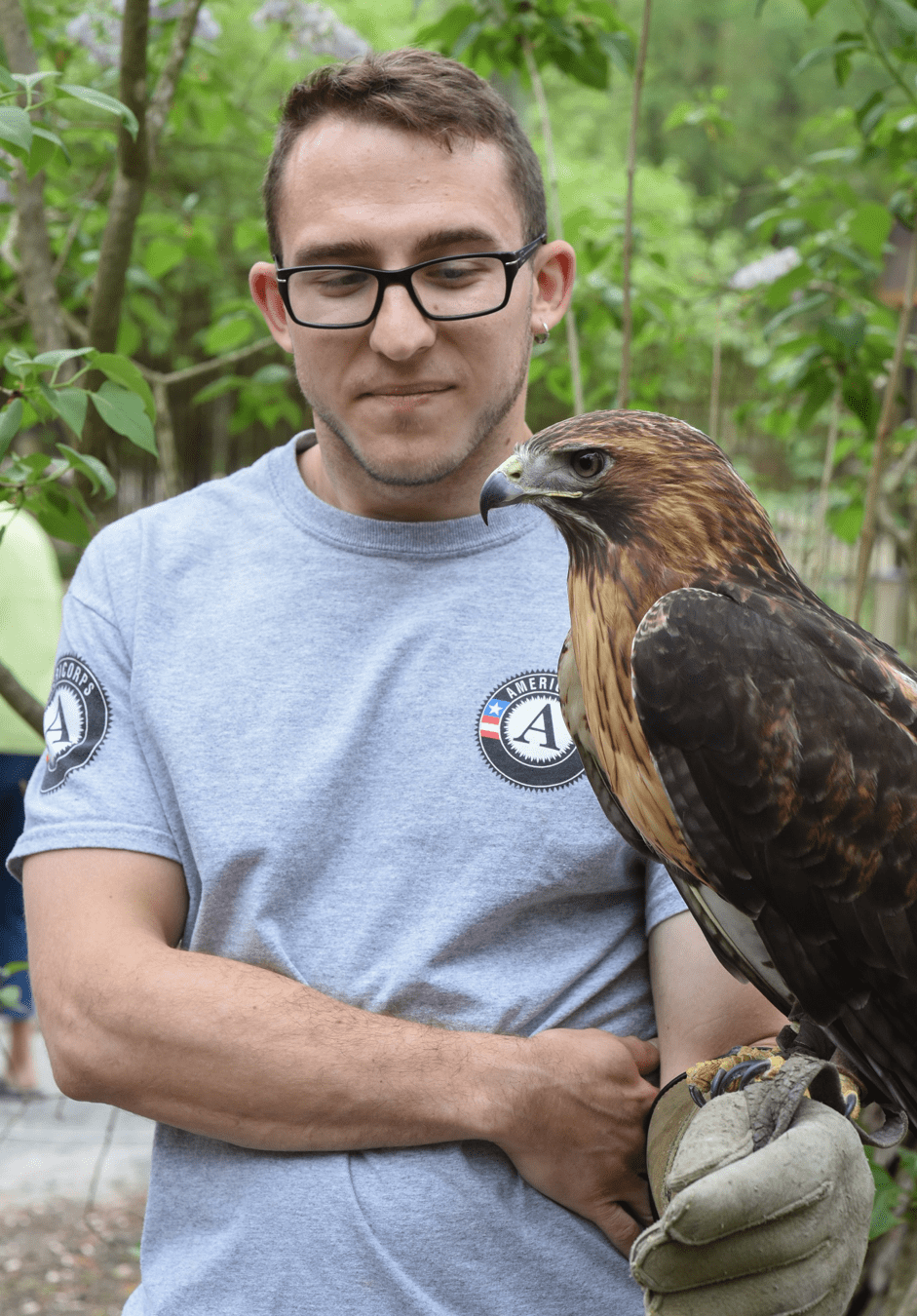
Nathan is a PhD candidate in the Thorne lab developing species distribution models to quantify climate change-driven range shifts in small odontocete species on the east coast of the United States. He is applying these distribution models to understand how changing habitat use affects the exposure of these species to anthropogenic threats, such as marine construction and bycatch. Nathan also developed the 3D models of humpback whales used in the lab to understand body condition in the New York Bight and in the North Atlantic. He is broadly interested in developing and applying cutting edge statistical techniques to better understand how marine mammals are adapting to a rapidly changing marine environment and the subsequent effects on the ecosystem. Nathan hails from Maryland, where he earned a B.Sc. in biology at Salisbury University and explored forage fish ecology at Chesapeake Biological Laboratories. In his free time, Nathan enjoys climbing with other members of the lab, playing games with friends, making coffee, and spending time with family.
Chelsi Napoli
chelsi(dot)napoli(at)stonybrook(dot)edu

Chelsi is a PhD student in the Thorne Lab within the Ecology and Evolution program at Stony Brook University. She earned her Bachelor’s degree in Biology from Pace University and gained experience working with science and conservation organizations before joining the lab. Her time as a whale watch naturalist sparked a passion for whales, which ultimately shaped her research focus. In the lab, she studies the health and conservation of humpback whales in the New York Bight. She uses drone photogrammetry to assess body condition of New York Bight humpback whales inter-annually and across foraging grounds, and to model the growth relationship between body length and age. Additionally, she’s using AIS data to examine how the risk of vessel strike to humpback whales on the East Coast has changed in both space and time. Outside the lab, she enjoys doing crosswords, making pasta, hiking, and reading.
Esther Nosazeogie
esther(dot)nosazeogie(at)stonybrook(dot)edu

When she is not studying birds, Esther is doing one of these: trying to get everyone else informed and excited about the natural world, soaking in the outdoors, or enjoying music, literature, and other forms of art.
Esther has a substack: naturestorynigeria.substack.com
Josh Meza-Fidalgo
joshua(dot)meza-fidalgo(at)stonybrook(dot).edu

identification and GIS to study the movements of bottlenose dolphins that forage in association with commercial shrimp trawlers for his master’s project. Prior to graduate school he worked on whale watching boats in California as crew, naturalist, and eventually USCG licensed Captain, was a blue whale photo identification intern with the Aquarium of the Pacific and was a research assistant for Gray Whales Count. In 2012 he earned his B.Sc. in biology from James Madison University. When he’s not working Josh enjoys spending time with his wife and dog, wildlife photography, reading and watching football.
Zach Hoffman
zachary(dot)k(dot)hoffman(at)stonybrook(dot).edu

Zach is a Master’s student using bioenergetics to assess how surfacing rates in baleen whales impact their risk of ship strikes. He obtained a Bachelor of Science in Environmental Studies from Gettysburg College in 2023, where he participated in a butterfly restoration project in and around Gettysburg National Military Park, and aquatic plant research during his semester abroad in Uganda. During his senior year, he led an independent study comparing bird bioacoustics, via nocturnal flight calls, to weather radar in quantifying the fall migration. Through this experience, Zach became fascinated with using emerging technologies to answer ecological questions, and subsequently found himself at the Thorne Lab. Outside of the lab, Zach enjoys playing video games with friends, climbing, and disc golfing.
Maddy Hallet
madeline(dot)hallet(at)stonybrook(dot).edu

Maddy is a PhD student studying giant petrel movement and habitat use in relation to wind. She received her B.S. in environmental sciences from the University of Washington in her hometown of Seattle. After graduating, she worked several field jobs, including a season doing avian point count surveys in Nevada, forestry work in Washington and Oregon, and fire ecology research in the Longleaf Pine forests of Georgia. She then went on to receive her M.A. in applied ecology at Stony Brook in Dr. Heather Lynch’s lab, writing her capstone on the distribution and abundance of Macaroni penguins in the Antarctic Peninsula region. She is broadly interested in wildlife conservation with a large taxonomic focus on birds, but has a love for all animals. When she isn’t thinking about birds, she enjoys playing video games, listening to lots of rock and indie music, rock climbing, and spending time with her cat Rufus.
Emma Pierce
emma(dot)pierce(at)stonybrook(dot).edu

Emma is a Master’s student in the Thorne Lab and is interested in studying marine predator movement and ecology. She received her B.S. in biological sciences and sustainability from the University of Notre Dame in 2024, where she studied the impacts of a stream restoration project on aquatic insect diversity in a local waterway. Emma also completed a summer REU program at the Ohio State University Stone Laboratory in 2023, researching how turbidity particles and predator presence within Lake Erie influence boldness and foraging behaviors in an invasive prey fish. Outside of the lab, Emma loves running, hiking, yoga, and traveling. In her hometown of Cleveland, Ohio, you can find her spending time with her family, including her golden retriever, Atlas.
Salome Pintado-Vertner
salome(dot)pintado-vertner(at)stonybrook(dot)edu

Salome is a senior undergraduate student in the Thorne Lab studying background noise in the New York Bight. She just finished an internship at the Shoals Marine Lab in Maine studying the effects of temperature on shark predations rates on seals in the Isles of Shoals. Salome is broadly interested in cetacean behavior, under water noise pollution and climate change and their effect on marine mammals, and marine invertebrate ecology and physiology. Outside of school Salome enjoys going to the beach, crocheting, and watching ocean documentaries.
Hannah Mearns
hannah(dot)mearns(at)stonybrook(dot)edu

Hannah is a Marine Conservation and Policy MA student fulfilling her capstone project in the Thorne lab. She is analyzing baleen whale habitat using glider detection of whales and their acoustic recordings. She earned her Bachelors of Science, magna cum laude, in Environmental Science at St. John’s University and played Division I softball. Her interests lie in behavioral ecology of marine mammals and broadly marine mammal acoustics. Outside of school you can find her soaking up sunshine, in the ocean, reading, and playing with her dog.
Magdalena Kelly-Miller
magdalena(dot)kelly-miller(at)stonybrook(dot)edu

Magdalena is in the Marine Conservation and Policy MA program, working on bottlenose dolphin photo-identification in the Thorne Lab. She earned her Bachelor of Arts in Environmental Studies and Latin American Studies at Marquette University. Magdalena is interested in the behavioral ecology of marine mammals, such as the relationship between mother and calf, changing migration patterns, and social structures. Furthermore, she is concerned with anthropogenic threats against cetaceans, like entanglements with fishing gear and vessel strikes. Outside of school, you can find her swimming, hiking, and reading.
Zachary Barnet
zachary(dot)barnet(at)stonybrook(dot)edu

Zack is a Master’s student who is interested in studying humpback whale behavior and ecology. He received his B.A in biology from Skidmore College in 2024. At Skidmore he worked in a number of research labs, studying biochemistry using gold nanoparticles, and plant-animal interactions using tobacco hornworms as a model. As a cellist and Filene Music Scholar at Skidmore, he fully embraced the liberal arts experience and participated in chamber music and orchestra. Zack discovered his passion for marine biology during his semester in New Zealand, where he was able to work on a research project using drones to monitor Polynesian humpback whale health. When he’s not working, Zack loves hiking, playing video games, practicing the cello, and hanging out with his dog, Treble.
Benjamin Cowles
benjamin(dot)cowles(at)stonybrook(dot)edu

Ben is a junior studying Marine Sciences at SoMAS. He is broadly interested in marine ecology and conservation with a focus in scientific diving and plans to pursue a masters degree here at Stony Brook University. His current project in the lab is investigating stranded bottlenose dolphin morphology as it relates to broad scale latitudinal distributions. In his free time, Ben likes to listen to music with friends, spend time outdoors, and rock climb.
Ciaran Edwards
ciaran(dot)edwards(at)stonybrook(dot)edu

Ciaran is a Master’s student in the Thorne lab from Lewiston, NY. He got his Bachelor of Arts in biology at Wesleyan University, where he was a member of the NCAA wrestling team and worked in a lab developing microbial solutions to agricultural nanoplastic pollution. As a research assistant at Niagara University, he studied prey-choice in freshwater zooplankton of the Niagara River and a meromictic lake in central upstate NY. Through this work, Ciaran developed an interest in predator-prey interactions and trophic ecology, and he hopes to pursue a project investigating these dynamics in higher level consumers in his work at Stony Brook. In his free time, Ciaran enjoys hiking, camping, going to the beach, and nature photography. He also coaches high school and college wrestling, including as a volunteer coach with the wrestling club at Stony Brook.
Stephanie Nehasil
stephanie(dot)nehasil(at)stonybrook(dot)edu

Stephanie is a senior postdoctoral associate investigating the spatial and temporal dynamics of North Atlantic right whale prey and the implications for right whale habitat use under changing oceanographic conditions.
She grew up in Northern California, where an early love for mountains and oceans sparked her passion for marine ecology. Stephanie earned dual degrees in Ecology & Evolution and French from UC Davis, followed by a master’s from Scripps Institution of Oceanography (SIO). She completed her PhD in Ecology, Behavior, & Evolution at UC San Diego, in collaboration with NOAA Fisheries, where she used biogeochemical analyses, bomb calorimetry, and Bayesian models to study predator trophic ecology in the California Current Ecosystem.
Her research explores how climate variability and anthropogenic stressors shape predator-prey dynamics and inform conservation strategies. She has held positions at both government and nonprofit institutions, including NOAA Fisheries, the San Francisco Zoological Society, The Marine Mammal Center, and SIO’s Birch Aquarium. Stephanie is also deeply committed to mentorship, outreach, and expanding access to science education for students from under-served communities.